Category: Reference material

  • Playing with Fire: Chemical Safety Expertise Required

    Playing with Fire: Chemical Safety Expertise Required

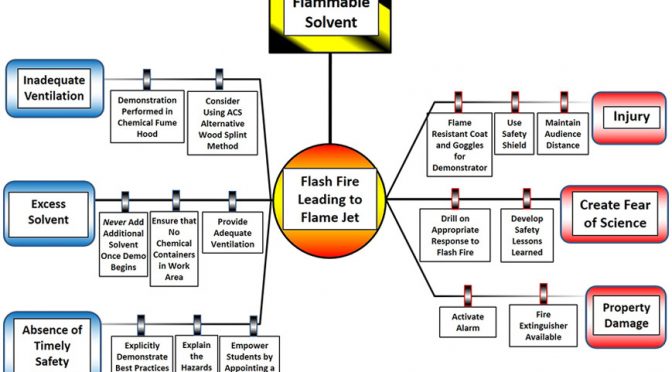
    Samuella B. Sigmann*of Appalachian State University in Boone, North Carolina and incoming chair of DCHAS authored a Journal of Chemical Education article on the ongoing history of flammable liquid incidents in educational settings. The article was chosen as an editor’s choice for August and is now available on an open access basis for free download.
    Congratulations, Sammye!
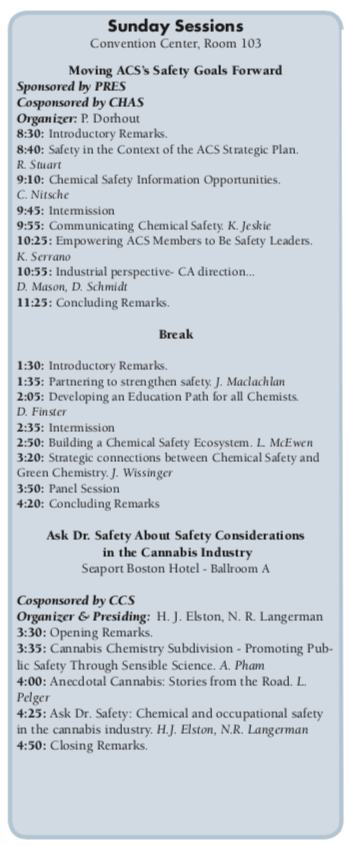
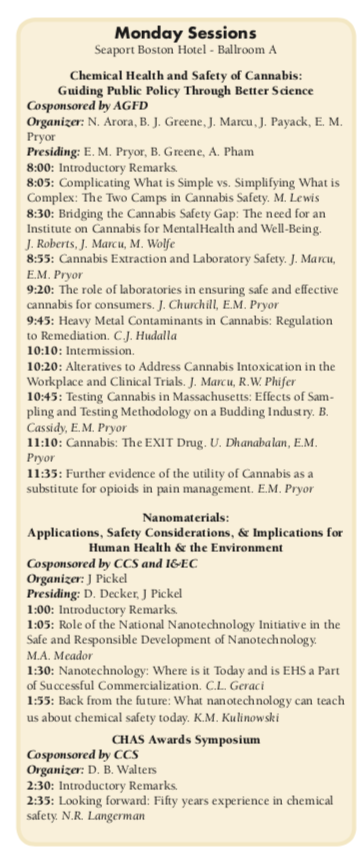
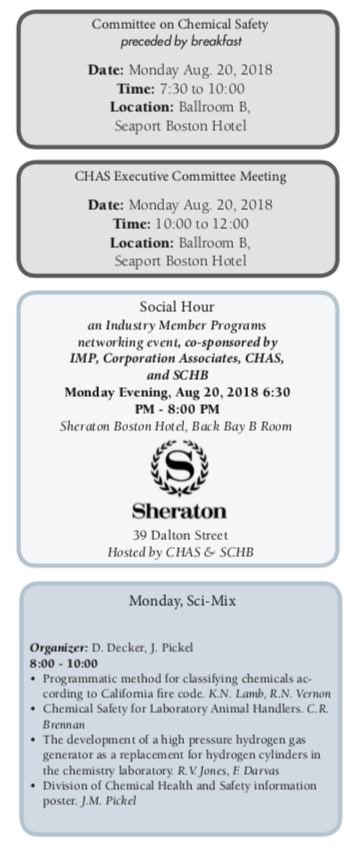
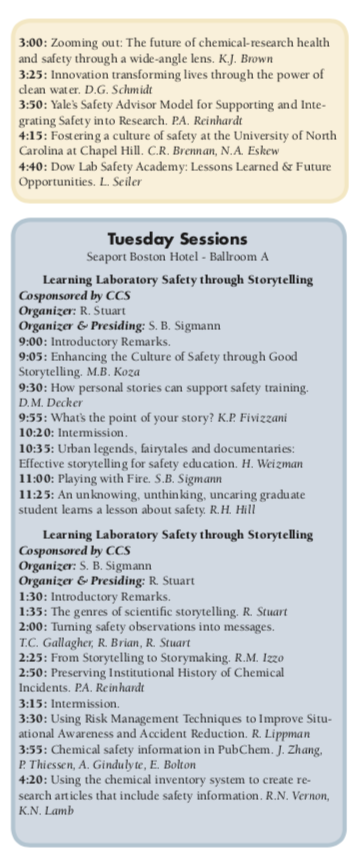
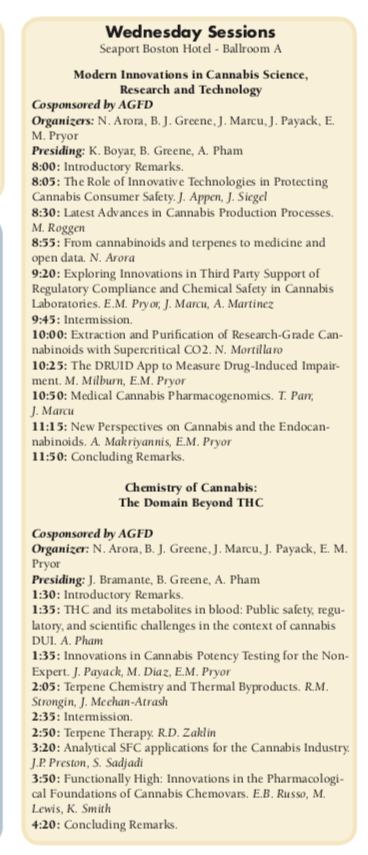
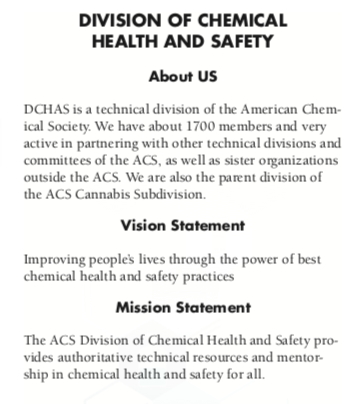
  • CHAS at a Glance for the Boston ACS Meeting

    CHAS at a Glance for the Boston ACS Meeting

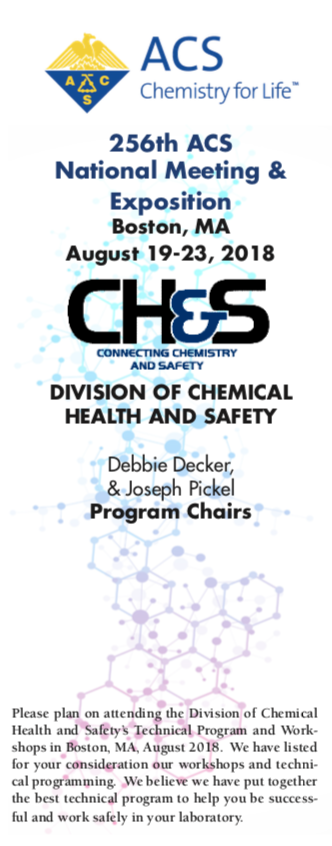
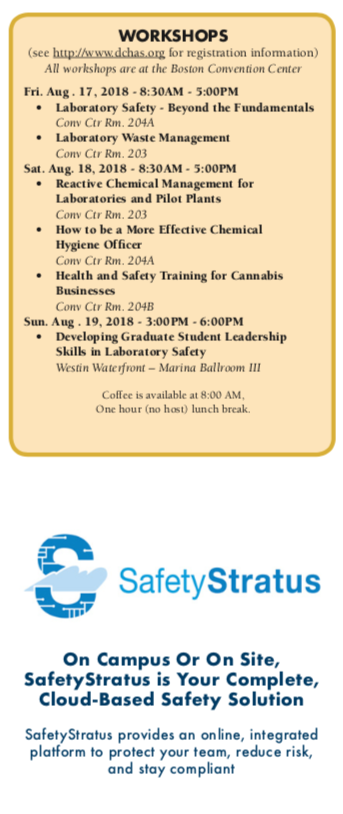
    You can download CHAS at a glance – Boston Fall 2018 for the Boston ACS National Meeting at this page.  The DCHAS Agenda Book 2018 Fall for the meeting is available here. Below is the information in a columnar format for easy scanning on a mobile device.


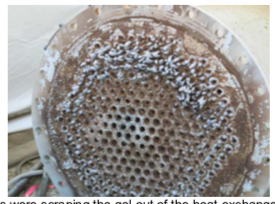
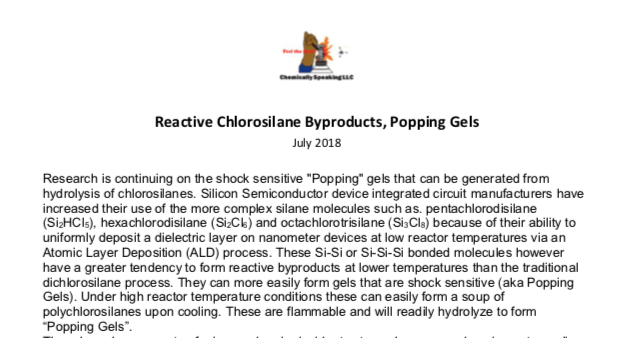
  • Reactive Chlorosilane Byproducts, Popping Gels

    Reactive Chlorosilane Byproducts, Popping Gels

    The attached document on Reactive Chlorosilane Byproducts was provided by Eugene Ngai, 2011 Howard Fawcett Chemical Health and Safety Award.

  • DCHAS Lab Risk Assessment Video available!

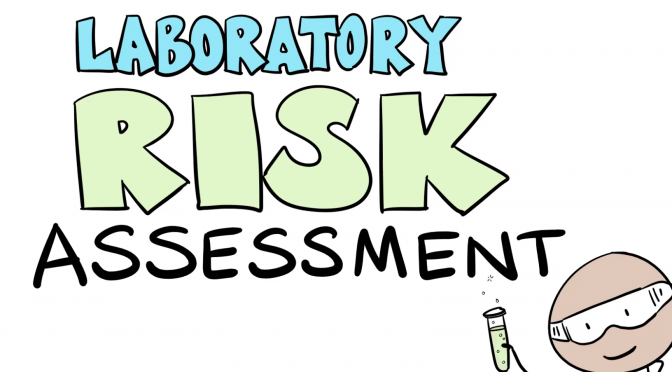
    DCHAS Lab Risk Assessment Video available!

    Thanks to an Innovative Project Grant from the American Chemical Society to the Division of Chemical Health and Safety, we are able to share the video below with the research chemistry community. The video is 2 minutes and 12 seconds long and provides an overview of the reasons that conducting a risk assessment of laboratory work is so important to maintaining situational awareness as laboratory work proceeds.

    The video is meant for sharing – it carries a non-commercial, by attribution Creative Commons license and can be downloaded here.

    In addition, the Division has developed a powerpoint file to serve as a teaching that accompanies the video. You can download the powerpoint file here:

    Our thanks for their help with this video to :
    1. Rachel Brian of Blue Seat Studios for her creativity
    2. Tim Gallagher of the University of Bristol in the UK for suggesting this video and his ongoing collaboration in developing the content
    3. The more that 300 people who viewed previous versions of the video and the many people who provided helpful suggestions for improving those versions.
    4. The ACS Innovative Projects Grant program for funding this project.

    Comments and questions about this video can be directed to Ralph Stuart, membership chair of DCHAS at membership@dchas.org

  • JCHAS Editor’s Spotlight: Chemical safety education for the 21st century

    JCHAS Editor’s Spotlight: Chemical safety education for the 21st century

    The Editor’s Spotlight for the May / June 2018 issue of the Journal of Chemical Health and Safety is shining on:

    Chemical safety education for the 21st century — Fostering safety information competency in chemists by
    Samuella Sigmann

    The abstract for this article is:

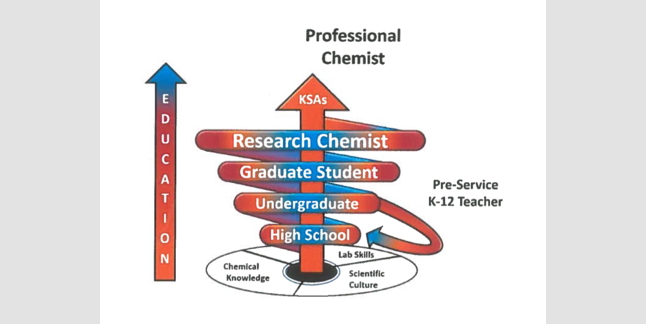
    During the education process, each person strives to acquire the necessary skill set or set of competencies needed to be successful in their selected career. For example, a job listing for a bench chemist might state that the successful applicant should have a BS in chemistry, (knowledge), be familiar with common laboratory operations (skills), and be a contributing member of a team (attitude). It is our job as curriculum designers and educators to give our students the competencies they will need to be successful. The chemistry curriculum must include those competencies needed for working safely in a chemistry research laboratory.

    This can be accomplished by weaving the knowledge component of competencies spirally into the chemistry major’s curriculum. We cannot assume that a student who has successfully completed a bachelor’s degree in chemistry has acquired the necessary competencies to perform a risk assessment or read a safety data sheet (SDS). Skill-based laboratory activity is valuable and can be specifically transferred to the next task, but knowledge and attitudes assist future learning in a nonspecific transfer and must be taught as ideas and principles. This work looks at the competencies required to be a chemist from an historical point and suggests ways that chemical safety information can be infused into the twenty-first century chemistry curriculum using embedded safety professionals, risk assessment, and SDSs to broaden and deepen safety knowledge.

    This article and the rest of the issue can be found at ScienceDirect site

    Also included in this issue of JCHAS are:

    Chemical safety information in the 21st century
    Ralph Stuart

    Collecting reaction incident information: Engaging the community in sharing safety learnings
    Carmen I. Nitsche, Gabrielle Whittick, Mark Manfredi

    Baseline survey of academic chemical safety information practices
    Leah McEwen, Ralph Stuart, Ellen Sweet, Robin Izzo

    The chemical safety gateway: Beyond Google’s limitations
    Abe Lederman, Sol Lederman

    ACS’s Hazard Assessment in Research Laboratories website: An important safety culture tool
    Kendra Leahy Denlinger

  • Health and Safety Training for Cannabis Businesses Workshop Description

    Health and Safety Training for Cannabis Businesses Workshop Description

    Presenters: Melissa Wilcox and Julia Bramante
    Saturday, August 18, 8:30 – 4 PM

    Health and safety training related to cannabis has become an urgent national priority. Recent studies suggest less than fifty percent of cannabis operators provide any health and safety training for their staff, and across all United States industries the number of workers who can use cannabis legally is increasing. This course is intended for employers in states where cannabis use is legal, as well as workers and staff throughout the cannabis industry. The course will cover topics important for individuals who work at cannabis operations.

    This comprehensive course presented by the American Chemical Society Chemical Health and Safety Division and the Cannabis Chemistry Subdivision is a review of methodologies, safety considerations and best practices related to working at cannabis operations whether it is a retail, manufacturing, cultivation, laboratory or a vertically integrated combination of those operations. Participants will learn how to comply with health and safety standards at each level of the supply chain. Policies and recommendations will be discussed for the following topics:  workplace safety, laboratory safety, personal protective equipment training, hazardous materials (HAZMAT), and handling law enforcement interactions.

    There is extensive opportunity for questions both during the workshop and with follow-up by phone and email. Each participant will receive workshop materials and resources.

    EXTRACTION, ANALYSIS, AND LAB SAFETY:

    • Cannabis Extraction and Analysis
    • Hazard identification 
    • Flammables and Explosives
    • Hazard Communication
    • Safety Data Sheets (SDS)
    • Laboratory Ergonomics
    • Laboratory Safety
    • Laboratory Emergency Preparedness

    WORKPLACE SAFETY:

    • General Workplace Safety
    • Back Safety
    • Confined Spaces
    • Ergonomics (in Industrial and/or Office settings)
    • Fall Prevention – Slips, Trips, and Falls
    • Food Security Awareness
    • Hand, Wrist, and Finger Safety
    • Identifying Workplace Hazards
    • Safety Audits
    • Hazard Emergency Response Plan
    • Incident Reporting/Investigation OSHA Recordkeeping (for Employees and/or Supervisors and Managers)
    • PPE Training:
    • General PPE Essentials
    • Hand and Foot Protection
    • Head, Eye, and Face Protection
    • Hearing and Respiratory Protection

    LAW ENFORCEMENT INTERACTIONS:

    • State and Federal Cannabis Laws
    • Knowing Your Rights
    • Preparing and Responding to Raids and Arrests

    HAZARDOUS MATERIALS (HAZMAT):

    • Globally Harmonized System for the Classification and Labeling of Chemicals (GHS)
    • Hazard Communications (for when working with hazardous chemicals)
    • Hazmat: Awareness, labeling, loading/unloading, marking, packaging, reporting, etc.
    • Hazmat Emergency Response Training
    • Hazmat: Security Awareness and Safety

    [sform]2[/sform]

    Registration Notes:
    One person may register for multiple workshops on a single Registration form. If you have more than one person to register using the same credit card or billing method or if you need help with the registration process, please contact Russ Phifer at 610-322-0657 or rphifer@wcenvironmental.com

    You will receive a confirmation that your registration has been submitted immediately upon registering. You will be sent a confirmation of registration email as soon as your registration is reviewed. Please contact 610-322-0657 if you do not receive the confirmation within four working days.

    Terms
    Members of ACS who are not also members of CHAS do not qualify for the CHAS member discount.

    Conditions and Cancellation/Refund Policy
    Upon verified registration, information will be sent to each participant containing specific location information of the workshop. Companies may substitute registrants without prior notice or penalty. Full refund available for cancellations up to three (3) weeks prior to workshop date. 50% refund up to one (1) week prior to workshop. Cancellations made less than seven (7) days prior to workshop start date will be charged, but an 80% credit may be applied toward a future program. No-shows receive no credit and will be billed. In the event that the Division of Chemical Health and Safety is forced to cancel a workshop due to lack of registration or other causes, CHAS will notify participants at least ten (10) days in advance by email. We will notify you by email as soon as we know that the workshops will be held, i.e. we have sufficient registrants to present the workshop. CHAS suggests fully refundable air fares be used due to the potential of workshop cancellation. CHAS will not be responsible for penalties caused by these types of fares in the event of workshop cancellation.
  • Laboratory Safety – Beyond the Fundamentals Workshop Description

    Laboratory Safety – Beyond the Fundamentals Workshop Description

    taught by Jim Kaufman, Lab Safety Institute
    Friday, August 17, 8:30 – 4 PM

    Description: The Laboratory Safety Institute (LSI) will present a new course at the ACS national meetings. The course meets the needs of scientists, science educators, lab workers and their supervisors wanting to learn more about laboratory safety. “Lab Safety – Beyond the Fundamentals” continues where LSI’s introductory course (The Laboratory Safety Workshop) leaves off and explores new areas in lab safety. There is an emphasis on simple and inexpensive steps to create more effective lab safety programs and grow the culture of lab safety.

    There is extensive opportunity for questions both during the workshop with follow-up by phone and email. This includes a one-hour conference call to help with the implementation of course concepts. Course participants are encouraged to submit in advance five questions/topics they wish to be sure are covered in the course: jim@labsafetyinstitute.org. Each participant will receive workshop materials (280-Page, three-ring Lab safety course notebook) and other photocopied resources.

    Specific Items Covered include:

    • Evaluating your Lab Safety Program
    • Fire Control
    • Lab Safety Equipment
    • Labeling
    • Chemical Handling (part II)
    • Compressed Gases
    • Laboratory Ventilation
    • Recordkeeping
    • Handling Lab Glassware
    • BREAK
    • Conducting Laboratory Inspections
    • Employee/Student Involvement
    • Safety Program Planning
    • Safety Information Resources
    • LAB SAFETY FORUM:
      Informal Roundtable Discussions for Interested Participants

    [sform]2[/sform]

    Registration Notes:
    One person may register for multiple workshops on a single Registration form. If you have more than one person to register using the same credit card or billing method or if you need help with the registration process, please contact Russ Phifer at 610-322-0657 or rphifer@wcenvironmental.com

    You will receive a confirmation that your registration has been submitted immediately upon registering. You will be sent a confirmation of registration email as soon as your registration is reviewed. Please contact 610-322-0657 if you do not receive the confirmation within four working days.

    Terms
    Members of ACS who are not also members of CHAS do not qualify for the CHAS member discount.

    Conditions and Cancellation/Refund Policy
    Upon verified registration, information will be sent to each participant containing specific location information of the workshop. Companies may substitute registrants without prior notice or penalty. Full refund available for cancellations up to three (3) weeks prior to workshop date. 50% refund up to one (1) week prior to workshop. Cancellations made less than seven (7) days prior to workshop start date will be charged, but an 80% credit may be applied toward a future program. No-shows receive no credit and will be billed. In the event that the Division of Chemical Health and Safety is forced to cancel a workshop due to lack of registration or other causes, CHAS will notify participants at least ten (10) days in advance by email. We will notify you by email as soon as we know that the workshops will be held, i.e. we have sufficient registrants to present the workshop. CHAS suggests fully refundable air fares be used due to the potential of workshop cancellation. CHAS will not be responsible for penalties caused by these types of fares in the event of workshop cancellation.
  • Laboratory Waste Management Workshop Description

    Laboratory Waste Management Workshop Description

    Taught by Russ Phifer, WC Enviromental
    Friday, August 17, 8:30 – 4 PM

    Description: CHAS offers the Laboratory Waste Management workshop to assist participants with the various regulatory requirements that apply to laboratories which generate hazardous waste, as well as to provide insight into the options for on-site management and off-site disposal. Includes details on the new Hazardous Waste Improvement Rule. Focus will include discussion on recycling/reclamation techniques, economical handling of wastes and liability issues. There is extensive opportunity for questions both during the workshop with follow-up by phone and email.

    Specific topics includes:

    • Environmental Controls
    • Laws/ Regulations
    • Clarifications/ Interpretations
    • Internal Policies
    • Hazardous Waste Regulations as they apply to Laboratories
    • Waste Determinations
    • Waste Lists / Waste Characteristics
    • Acute Wastes
    • Mixtures
    • Empty Containers
    • Satellite Storage
    • Academic Lab Waste Rule
    • Other Regulatory Requirements & Issues
    • Liability – Superfund/CERCLA
    • Personal vs. institutional liability
    • Down the drain / in the trash
    • Compatibility
    • Waste Minimization
    • Recycling / Reclamation
    • Part of process treatment
    • Onsite Handling of Lab Wastes
    • Storage
    • Consolidation
    • Working with Vendors
    • Vendor selection
    • Contracting
    • Transportation / brokers / packagers
    • Economics

    [sform]2[/sform]

    Registration Notes:
    One person may register for multiple workshops on a single Registration form. If you have more than one person to register using the same credit card or billing method or if you need help with the registration process, please contact Russ Phifer at 610-322-0657 or rphifer@wcenvironmental.com

    You will receive a confirmation that your registration has been submitted immediately upon registering. You will be sent a confirmation of registration email as soon as your registration is reviewed. Please contact 610-322-0657 if you do not receive the confirmation within four working days.

    Terms
    Members of ACS who are not also members of CHAS do not qualify for the CHAS member discount.

    Conditions and Cancellation/Refund Policy
    Upon verified registration, information will be sent to each participant containing specific location information of the workshop. Companies may substitute registrants without prior notice or penalty. Full refund available for cancellations up to three (3) weeks prior to workshop date. 50% refund up to one (1) week prior to workshop. Cancellations made less than seven (7) days prior to workshop start date will be charged, but an 80% credit may be applied toward a future program. No-shows receive no credit and will be billed. In the event that the Division of Chemical Health and Safety is forced to cancel a workshop due to lack of registration or other causes, CHAS will notify participants at least ten (10) days in advance by email. We will notify you by email as soon as we know that the workshops will be held, i.e. we have sufficient registrants to present the workshop. CHAS suggests fully refundable air fares be used due to the potential of workshop cancellation. CHAS will not be responsible for penalties caused by these types of fares in the event of workshop cancellation.