Tag: editors spotlight

  • JCHAS Editor's Spotlight: A 4 Way Tie!

    JCHAS Editor's Spotlight: A 4 Way Tie!

    The JCHAS Editor’s Spotlight for the November / December 2019 issue of the Journal of Chemical Health and Safety is shining on 4 articles, all written by former chairs of the Division!

    The first presents an innovative approach to assessing heat stress concerns while wearing personal protective equipment.

    Then there is a suite of three articles that describe safety culture development programs in variety of settings (undergraduate instruction, academic research support, and industrial laboratory settings).

    In addition, there are articles assessing the impact of safety cultures in several settings and 4 articles on interesting approaches to improving ventilation in chemical settings.

    Note: This is the final issue of JCHAS that is published under the Division’s contract with Elsevier. Starting in 2020, the Journal will be published by the American Chemical Society’s publications division. This will change how members access the journal. Let me know if you have any questions about this change.

    Journal of Chemical Health and Safety,
    November–December 2019

    Editor’s Spotlight: Predicting and preventing heat stress related excessive exposures and injuries: A field-friendly tool for the safety professional
    Harry J. Elston, Michael J. Schmoldt

    Editor’s Spotlight: Industrial lab safety committees and teams — Case study
    Kenneth P. Fivizzani Pages 71-74

    Editor’s Spotlight: DiSCO — Department Safety Coordinators and Officers: Building Safety Culture
    Victor Duraj, Debbie M. Decker Pages 84-88

    Editor’s Spotlight: Incorporating chemical safety awareness as a general education requirement — Case study
    Frankie Wood-Black

    Chemistry laboratory safety climate survey (CLASS): A tool for measuring students’ perceptions of safety
    Luz S. Marin, Francisca O. Muñoz-Osuna, Karla Lizbeth Arvayo-Mata, Clara Rosalía Álvarez- Chávez

    Assessing graduate student perceptions of safety in the Department of Chemistry at UC Davis
    Brittany M. Armstrong

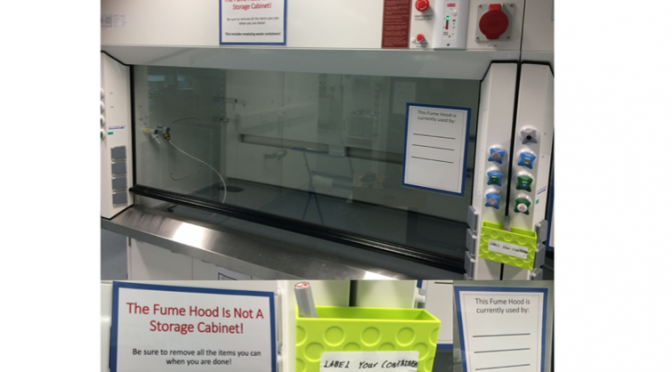
    Use of Lean Six Sigma methods to eliminate fume hood disorder
    Hugo Schmidt

    Computational fluid dynamics (CFD) modelling on effect of fume extraction
    Kar Yen Sam, Siong Hoong Lee, Zhen Hong Ban Pages 20-31

    Anatomy of an incident: A hydrogen gas leak showcases the need for antifragile safety systems
    Hugo Schmidt

    Cleaning diamond surfaces using boiling acid treatment in a standard laboratory chemical hood
    Kimberly Jean Brown, Elizabeth Chartier, Ellen M. Sweet, David A. Hopper, Lee C. Bassett

    In Your Face: Consideration of higher risks for chemical exposure to persons with disabilities in laboratories
    Janet S. Baum, Amie E. Norton

    Lessons learned — Vacuum pump fire
    Elizabeth Czornyj, Imke Schroeder, Nancy L. Wayne, Craig A. Merlic

    Pilot study predicting core body temperatures in hot work environments using thermal imagery
    Jacob B. Thomas, Leon Pahler, Rodney Handy, Matthew S. Thiese, Camie Schaefer

  • JCHAS Editor’s Spotlight: Engaging senior management to improve safety culture

    JCHAS Editor’s Spotlight: Engaging senior management to improve safety culture

    The JCHAS Editor’s Spotlight for the July / October 2019 issue of the Journal of Chemical Health and Safety is shining on:

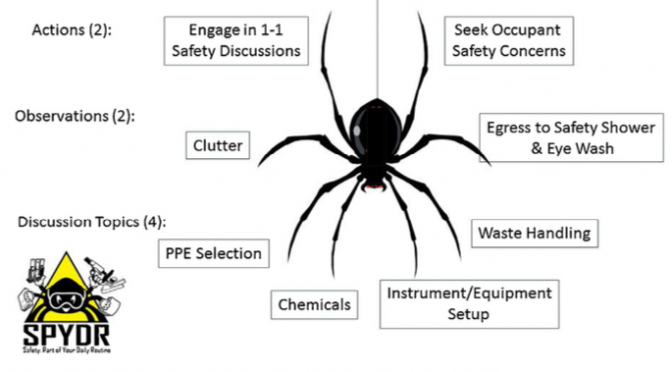
    Engaging senior management to improve the safety culture of a chemical development organization thru the SPYDR (Safety as Part of Your Daily Routine) lab visit program

    By Victor Rosso, Jeffery Simon, Matthew Hickey, Christina Risatti, Chris Sfouggatakis, Lydia Breckenridge, Sha Lou, Robert Forest, Grace Chiou, Jonathan Marshall, Jean Tom

    All authors are affiliated with Chemical & Synthetic Development, Bristol-Myers Squibb Company,

    You can download the article here:

    • Failure to educate — Failure to train; Harry J. Elston
    • Strategic opportunities in chemical safety education: A report on the 2019 ACS Safety Summit; Ralph Stuart
    • Lessons learned – Mercury thermometer incident; Elizabeth Czornyj, Imke Schroeder, Nancy L. Wayne, Craig A. Merlic
    • An immediate onsite chlorine leakage disaster management plan; Yehya Elsayed, Abdel-Qader Al-Ameri, Taj El-Sir Ahmed, Mohamed Idreese, Sofian Kanan
    • Evaluation of the implementation of occupational health, safety, and environment management systems in higher education laboratories; Fatma Lestari, Anom Bowolaksono, Sri Yuniautami, Tia Retno Wulandari, Saraswati Andani
    • Elements of experiment safety in the laboratory; Lee C. Cadwallader, Robert J. Pawelko
    • Looking at the bigger picture: Evaluating responder risk in a tritium spill; Harry J. Elston, Daren Perrero
    • A storage cabinet design for research chemicals for developing nations; Abdullah Hussein Kshash
    • Efficacy of existing transient models for spill area forecasting; Raja S., Reddy T.L.P., Tauseef S.M., Tasneem Abbasi, S.A. Abbasi

    CHAS members can access this issue at https://www.sciencedirect.com/journal/journal-of-chemical-health-and-safety?dgcid=raven_sd_via_email


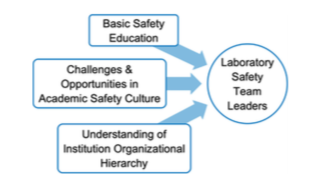
  • JCHAS Editor’s Spotlight: Impact of a pilot laboratory safety team workshop

    JCHAS Editor’s Spotlight: Impact of a pilot laboratory safety team workshop

    The JCHAS Editor’s Spotlight for the May / June 2019 issue of the Journal of Chemical Health and Safety is shining on:

    Impact of a pilot laboratory safety team workshop
    by Kali A. Miller and Kaitlin I. Tyler

    This issue includes several articles related to the 2018 CHAS Presidential Symposium on Safety in the Chemistry Laboratory, including a Foreword by 2018 ACS President Peter Dorhout. The table of contents for this issue is:

    This issue includes several articles related to the 2018 CHAS Presidential Symposium on Safety in the Chemistry Laboratory, including a Foreword by 2018 ACS President Peter Dorhout. The table of contents for this issue is:

    • Recognizing and understanding hazards — The key first step to safety by Robert H. Hill Jr.
    • A step in the right direction by Dawn C. Mason
    • Bringing Safety to Chemistry for Life by Ralph Stuart, Joseph M. Pickel
    • Impact of a pilot laboratory safety team workshop by Kali A. Miller, Kaitlin I. Tyler
    • Promoting safety culture: An overview of collaborative chemical safety information initiatives by Carmen I. Nitsche

    CHAS members can access this issue at https://www.sciencedirect.com/journal/journal-of-chemical-health-and-safety?dgcid=raven_sd_via_email


  • JCHAS Editor’s Spotlight: Catching Up With Runaway Hot Plates

    JCHAS Editor’s Spotlight: Catching Up With Runaway Hot Plates

    The JCHAS Editor’s Spotlight for the March / April 2019 issue of the Journal of Chemical Health and Safety is shining on:

    Catching up with Runaway Hot Plates, by Joseph M. Pickel, Mark Mathews, and Kimberly Brown

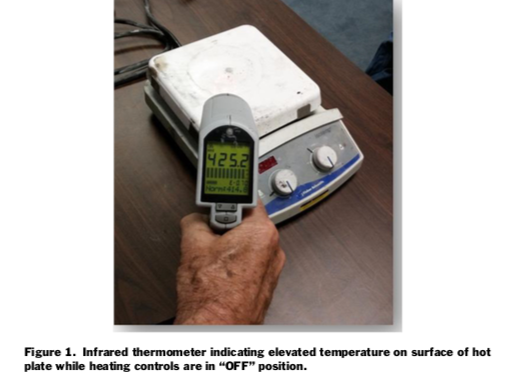
    In recent years, there have been numerous reports of “runaway hot plates”. This is to say, hot plates that heat uncontrollably regardless of the temperature setting or whether the controls are in the off position. Some of these events have resulted in injuries to laboratory personnel and damage to research facilities. Investigations into the cause of several of these events have determined that failure of a non-mechanical switch, a “triac”, in the hot plate can result in the circuit failing open, causing uncontrolled heating. The number of events in recent years has led to greater awareness of the issue; however, in spite of this, devices utilizing this technology continue to be sold and used in research laboratories without additional controls to ensure their safety.

    You can download the paper here:

    Other articles in this issue of JCHAS include:

    An evaluation of engineered nanomaterial safety data sheets for safety and health information post implementation of the revised hazard communication standard
    Laura Hodson, Adrienne Eastlake, Richard Herbers

    Evaluation of emissions and exposures at workplaces using desktop 3-dimensional printers
    A.B. Stefaniak, A.R. Johnson, S. du Preez, D.R. Hammond, J.R. Wells, J.E. Ham, R.F. LeBouf, K.W. Menchaca, S.B. Martin, M.G. Duling, L.N. Bowers, A.K. Knepp, F.C. Su, D.J. de Beer, J.L. du Plessis

    A retrospective analysis of compensable injuries in university research laboratories and the possible prevention of future incidents
    Abha Gosavi, Markus Schaufele, Michael Blayney

    Safe plunge freezing
    Robert C. Klein, Brent Lewchik, Simon White

  • Explosive precursor safety: An application of the Deming Cycle for continuous improvement

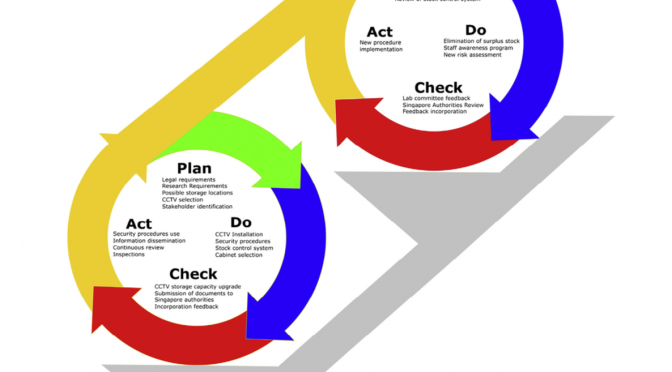
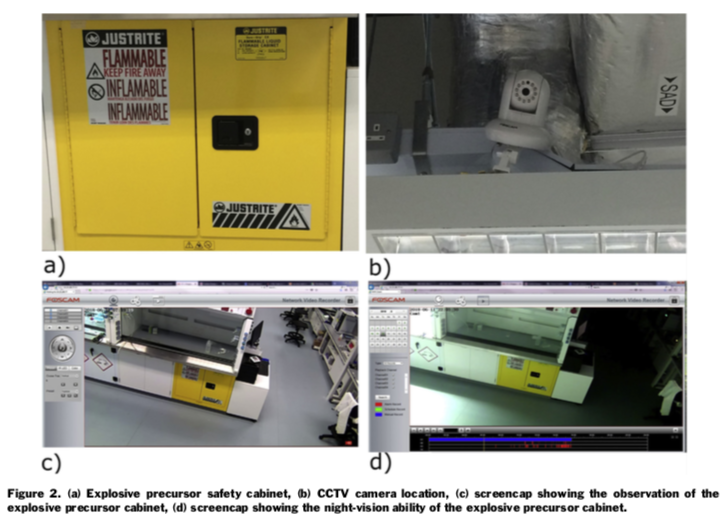
    Explosive precursor safety: An application of the Deming Cycle for continuous improvement

    The Editor’s Spotlight for the January / February 2019 issue of the Journal of Chemical Health and Safety is shining on: Explosive precursor safety: An application of the Deming Cycle for continuous improvement by Hugo Schmidt who is affiliated with Cambridge CARES in Singapore.

    The abstract for this article is:
    General safety regulations need to follow a ‘one size fits all’ model, which may lead them to inadequately address challenges posed by different individual use scenarios. Hence, the regulatory requirements are best regarded as an essential minimum level of safety; further improvement essential. Discussed here is a model for developing an explosive precursor safety system. With the Singapore legal requirements for an explosive precursor as the minimum, the Deming Cycle for continuous improvement was used to develop a fully mature safety program, across two Plan-Do-Check-Act cycles that incorporated feedback and observation of continuous practice.

    You can access this article at the link below and other articles from
    the JCHAS web page

  • JCHAS Editor’s Spotlight for Nov / Dec 2018

    JCHAS Editor’s Spotlight for Nov / Dec 2018

    The Editor’s Spotlight for the November / December 2018 issue of the Journal of Chemical Health and Safety is shining on:

    Expedient destruction of organic peroxides including triacetone triperoxide (TATP) in emergency situations by Damien Reid, Bruce Riches, Andrew Rowan, Michael Logan

    You can download the paper in PDF format here.

    The authoring team are:

    • Damien Reid is affiliated with Research and Scientific Branch, Queensland Fire and Emergency Ser- vices, G.P.O. Box 1425, Brisbane, Queensland 4001, Australia.
    • Bruce Riches is affiliated with Research and Scientific Branch, Queensland Fire and Emergency Services, G.P.O. Box 1425, Brisbane, Queensland 4001, Australia.
    • Andrew Rowan is affiliated with Forensic Services Group, Queensland Police Service, Australia.
    • Michael Logan is affiliated with Research and Scientific Branch, Queensland Fire and Emergency Ser- vices, G.P.O. Box 1425, Brisbane, Queensland 4001, Australia
    Other papers in this issue include:

    Boston safety! 
    Harry J. Elston 

    Comment on Letter from Dr. Edward Behrman – Laboratory Safety – A Contrary View 
    Robert H. Hill 

    Lessons learned in several laboratory upgrades 
    L.C. Cadwallader, R.J. Pawelko 

    Safety culture and safety compliance in academic laboratories: A Canadian perspective 
    Helene-Rosina Ayi, Chun-Yip Hon 

    Incomplete understanding of biogas chemical hazards — Serious gas poisoning accident while unloading food waste at biogas plant 
    Frank Huess Hedlund, Michael Madsen 

    Expedient destruction of organic peroxides including triacetone triperoxide (TATP) in emergency situations 
    Damien Reid, Bruce Riches, Andrew Rowan, Michael Logan 
  • JCHAS Editor’s Spotlight: Chemical suicides: Hazards and how to manage them

    JCHAS Editor’s Spotlight: Chemical suicides: Hazards and how to manage them

    The Editor’s Spotlight for the March / April 2018 issue of the Journal of Chemical Health and Safety is shining on:

    Chemical suicides: Hazards and how to manage them by
    Michael Logan and Christina  Baxter

    Michael Logan is affiliated with Research and Scientific Branch, Queensland Fire and Emergency Services, GPO BOX 1425, Brisbane, Queensland 4001, Australia.

    Christina Baxter is affiliated with Emergency Response TIPS, LLC, Woodbridge, Virginia 22191, USA.

    The abstract for this article is:

    Emergency response to chemical suicides has become more common place in recent years. In order to address the operational implications of these events, it is first important to understand the methodologies which are commonly used, the locations where the events often occur, the concentrations of material generated, and how those concentration relates to exposure standards and flammability. Using hydrogen sulfide, carbon monoxide, hydrogen cyanide, and phosphine as examples, guidance is offered about risk control measures including personal protective equipment and decontamination strategies to effectively and safely mitigate the incidents.

    This article and the rest of the issue can be found at ScienceDirect site

    Also included in this issue of JCHAS are:

    Expanding our Boarders: Safety at ABCChem 2018

    Anatomy of an incident—Multiple failure of safety systems under stress
    Hugo Schmidt

    Make safety a habit!
    Robert H. Hill

    The state of the arts: Chemical safety — 1937 to 2017
    Monona Rossol

    Contamination control monitoring at the Los Alamos National Laboratory’s Plutonium Facility
    Michael E. Cournoyer

  • JCHAS Editor’s Spotlight: A methodology on how to create a real-life relevant risk profile for a given nanomaterial

    JCHAS Editor’s Spotlight: A methodology on how to create a real-life relevant risk profile for a given nanomaterial

    The Editor’s Spotlight for the January / February 2018 issue of the Journal of Chemical Health and Safety is shining on:

    A methodology on how to create a real-life relevant risk profile for a given nanomaterial
    by Christa Schimpel, Susanne Resch,  Guillaume Flament,  David Carlander, and Izaskun Bustero

    The abstract for this Open access article is:

    With large amounts of nanotoxicology studies delivering contradicting results and a complex, moving regulatory framework, potential risks surrounding nanotechnology appear complex and confusing. Many researchers and workers in different sectors are dealing with nanomaterials on a day-to-day basis, and have a requirement to define their assessment/management needs.

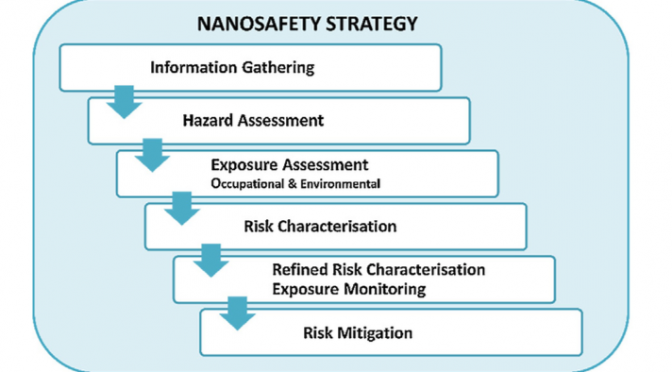
    This paper describes an industry-tailored strategy for risk assessment of nanomaterials and nano-enabled products, which builds on recent research outcomes. The approach focuses on the creation of a risk profile for a given nanomaterial (e.g., determine which materials and/or process operation pose greater risk, where these risks occur in the lifecycle, and the impact of these risks on society), using state-of-the-art safety assessment approaches/tools (ECETOC TRA, Stoffenmanager Nano and ISO/TS 12901-2:2014).

    The developed nanosafety strategy takes into account cross-sectoral industrial needs and includes:

    • (i) Information Gathering: Identification of nanomaterials and hazards by a demand-driven questionnaire and on-site company visits in the context of human and ecosystem exposures, considering all companies/parties/downstream users involved along the value chain;
    • (ii) Hazard Assessment: Collection of all relevant and available information on the intrinsic properties of the substance (e.g., peer reviewed (eco)toxicological data, material safety data sheets), as well as identification of actual recommendations and benchmark limits for the different nano-objects in the scope of this projects;
    • (iii) Exposure Assessment: Definition of industry-specific and application-specific exposure scenarios taking into account operational conditions and risk management measures;
    • (iv) Risk Characterisation: Classification of the risk potential by making use of exposure estimation models (i.e., comparing estimated exposure levels with threshold levels);
    • (v) Refined Risk Characterisation and Exposure Monitoring: Selection of individual exposure scenarios for exposure monitoring following the OECD Harmonized Tiered Approach to refine risk assessment;
    • (vi) Risk Mitigation Strategies: Development of risk mitigation actions focusing on risk prevention.

    This article and the rest of the issue can be found at ScienceDirect site

    Also included in this issue of JCHAS are:

    Don’t ever tell me…
    Harry J. Elston

    Photocatalytic degradation of phenol solution using Zinc Oxide/UV
    Original research article
    H. Dewidar, S.A. Nosier, A.H. El-Shazly

    A methodology on how to create a real-life relevant risk profile for a given nanomaterial
    Open access – Original research article
    Christa Schimpel, Susanne Resch,  Guillaume Flament,  David Carlander, and Izaskun Bustero

    A case history of legacy chemical cleanup in the lab
    Original research article
    L.C. Cadwallader, R.J. Pawelko

    Development of custom calibration factors for respirable silica using standard methods compared to photometric monitoring data
    Pages 27-35
    Leon F. Pahler, Danielle D. McKenzie-Smith, Rodney G. Handy, Darrah K. Sleeth

    Engineering intervention to reduce API dust exposure during milling operation
    Original research article
    Vivek Kanjiyangat, Manikandan Hareendran

    UPCOMING EVENTS

  • JCHAS Editor’s Spotlight: Comparison between active and passive workplace sampling

    JCHAS Editor’s Spotlight: Comparison between active and passive workplace sampling

    The Editor’s Spotlight for the November / December 2017 issue of the Journal of Chemical Health and Safety is shining on:

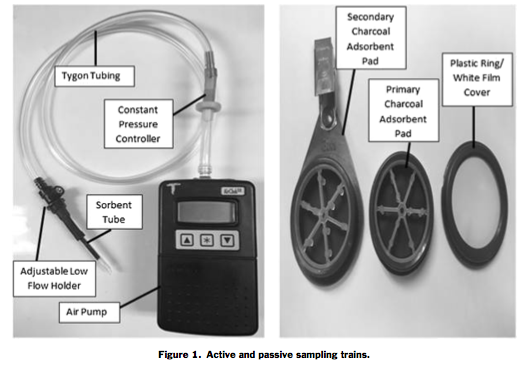
    A comparison study between passive and active workplace personal air monitoring techniques for airborne isopropyl alcohol concentrations
    by
    Austin K.Simons, Rodney G.Handy, Darrah K.Sleeth, Leon F.Pahler and Matthew S.Thiese

    The abridged abstract is:
    This research project involved a comparison between the performance of active and passive sampling methods used to collect isopropyl alcohol vapor in an industrial setting. This field experiment was conducted in a real-world industry setting with workers exposed to isopropyl alcohol. Based on the strong correlation values and the trend of passive samplers reporting higher results than the active samplers, occupational health specialists could reliably use the passive samplers in this study to demonstrate compliance to isopropyl alcohol exposure limits.

    This article and the rest of the issue can be found at
    http://www.sciencedirect.com/journal/journal-of-chemical-health-and-safety/vol/24/issue/6

    Also included in this issue of JCHAS are:

    Editorial: What a year!
    Harry J. Elston

    Safety and ethics in ACS and major scientific and engineering societies: A gap analysis
    Daniel R. Kuespert

    Response letter from CEPA to “Safety and Ethics in ACS and Major Scientific and Engineering Societies: A Gap Analysis”
    The ACS Committee on Economic and Professional Affairs

    Safety and health risk perceptions: A cross-sectional study of New Jersey hair and nail salon clients
    Lindsey J. Milich, Derek G. Shendell, Judith M. Graber

    UN-GHS — Physical hazard classifications of chemicals: A critical review of combinations of hazard classes
    Cordula Wilrich, Elisabeth Brandes, Heike Michael-Schulz, Volkmar Schröder, Klaus-Dieter Wehrstedt

    A comparison of occupational exposure limits and their relationship to reactive oxide species
    Original research article
    Tracy Zontek, Burton R. Ogle, Scott Hollenbeck, John T. Jankovic