Dr. Glenn Seaborg reflects on plutonium, lab safety, and DivCHAS
May/June 1998
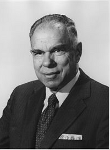
Glenn T. Seaborg, world-renown radiochemist, co-discovered plutonium and nine other transuranium elements. While working on the Manhattan Project, he devised a method of extracting and purifying plutonium. In 1944, his “actinide concept” of heavy element electronic structure changed the periodic table to include the transition series of transuranium elements. Dr. Seaborg shared the 1951 Nobel Prize in chemistry for his work with the new elements.
In 1947, President Harry Truman appointed Dr. Seaborg to the newly established Atomic Energy Commission. Dr. Seaborg continued his public service work as an advisor to the next six administrations and, under President Ronald Reagan, as a member of the National Commission on Excellence in Education. Dr. Seaborg has served as president of the American Chemical Society (1976) and the American Association for the Advancement of Science (1973). Today, he works to further a national commitment to basic scientific research and the safe management of nuclear materials. Editor Carl Gottschall spoke with Dr. Seaborg about the challenges of working safely in a brand new field of chemistry.
Gottschall: Why did you become a chemist?
Seaborg: I was inspired by a high school teacher. I had taken no science in grammar schools or the first two year of high school – my freshman and sophomore years – because I didn’t really have any background that sent me in that direction.
In my junior year, it was pointed out that if I didn’t have a laboratory course in science, I wouldn’t be eligible for admission to the tuition-free state university, which was UCLA. So I took chemistry.
I went to a small high school in the Watts neighborhood of Los Angeles, where I was bused in because we did not have a high school where I was living. My high school chemistry teacher just turned me on to chemistry. His name was Dwight Logan Reid. He not only taught chemistry, he preached it. He told us about the controversies that were raging and the personalities in chemistry. He had us on the edge of our seats.
Then, in my senior year, I had the same teacher. It was a small high school, and they alternated between teaching chemistry and physics. I liked physics even better. But in those day (I graduated from high school in 1929(, there didn’t seem to be any outlets of good chances for employment for a physicist, so I majored in chemistry at UCLA and, of course, at Berkeley, where I got my PhD I took as much physics as I did chemistry. I did my PhD research at Berkeley in nuclear physics but got a PhD in chemistry.
Gottschall: That certainly would help explain why you did so well in radiochemistry, which is a combination of physics and chemistry.
Seaborg: I did most of my research on the borderline between physics bad chemistry.
Gottschall: Perhaps that boundary was too arbitrarily assigned. As I recall, you were instrumental in the formation of the ACS Division of Chemical Health and Safety.
Seaborg: Yes, I reviewed my journals on that. I can tell you how it came about. The proposal for a new division came to a climax at the meeting of the American Chemical Society in Washington, DC in September, 1979. It was announced that the Committee on Divisional Activities opposed the elevation of the provisional Chemical Health and Safety to full division status. They opposed it on some kind of a formality – that it hadn’t met the reporting requirements or something like that.
I attended a meeting of what was called the Science Commission at that time. I knew Howard Fawcett then. He had convinced me of the importance of the Chemical Health and Safety Group becoming a full division. I advocated strongly at the meeting of the Science Commission that this be done. This was actually on September 12 (the first meeting with the Science Commission was on September 11). On September 12, I also attended the meeting of the ACS Council. In that meeting, the chair of the Committee on Divisional Activities, Barbara Montague, recommended rejection of divisional status for the Chemical Health and Safety Group.
Then, at my urging, Chair Warren Falcones of the Science Commission moved that the group be given divisional status, and carried by a voice vote in the Council meeting despite the earlier recommendation of the chair of the Committee on Divisional Activities that the motion for the recommendation for divisional status be rejected.
Gottschall: It has been recognized for years that the division owes quite a lot to your advocacy as well as your eloquence in persuading the Council. That’s not always an easy task. Even now, with so much emphasis on chemical health and safety is only a small fraction of ACSs overall membership. Do you have any ideas on what the ACS should be doing to stress the importance of chemical health and safety?
Seaborg: Perhaps articles like this might give publicity to it.
Gottschall: Perhaps-your eloquence will carry the day again.
Seaborg: I hope so, yes.
Gottschall: As a pioneer in radio-chemistry, you were very well aware of the importance of health and safety evaluations and precautions. How did you handle the same aspects of working with a new element – plutonium
Seaborg: I can give you some history there. I was at the wartime Metallurgical Laboratory at the Manhattan Project of the Plutonium Project Part of the Manhattan Distract at the University of Chicago.
When the first ponderable, visible, weighable amounts of plutonium came into the laboratory from the power plant at Oak Ridge in January, 1944, it suddenly occurred to me that the radiation-monitoring people, I guess you might call them the health physicists, hadn’t given an any attention to the danger from alpha-particle emitters like plutonium. All of the precautions and protections that they had devised were for gamma radiation; you know lead shields, for example.
In view of the problems that had occurred in the late teens and early 1920’s with the radium dial painters, I realized that the ingestion of just a little bit of plutonium would be a greater danger that then radiation from gamma emitters.
So I got in touch with the medical authorities and called the danger to their attention. The led, over a period of a couple of months, to a recognition of the problem and a renovation of the entire laboratory to include additional hood space and air monitoring.
The renovation also included putting linoleum on the floors and covering the walls with shellac that that would could be easily washed down. In general there arose a whole new regime of care in working with the radioactive substances.
The result of these precautions in spite of the fact that we handled plutonium in increasing amounts was that in the ensuing months of 1944 and 1945, nobody in my section suffered from plutonium poisoning. (I was leader of what called Chemistry Section C-1, which at its peak had about 100 scientists, BSs and PhDs.)
Gottschall: The is truly remarkable when you see all of the elaborate glove boxes and –
Seaborg: We developed the glove boxes
Gottschall: I think that is a super example of chemical health and safety at work, although perhaps we should give physical a little bit of credit there also.
Seaborg: Yes, I think so.
Gottschall: What incident or situation involving you personally do you feel was the most potentially hazardous to your health? Potentially, since obviously you are in good health.
Seaborg: It would have been hazardous for me to go into the laboratory if there if they had plutonium in solution; you know, they were stirring with stirring rods and having floating around in the air and so forth. I would say that was probably the most potentially hazardous situation, when we began to have plutonium in visible, ponderable amounts.
Gottschall: Did you wear respirators then?
Seaborg: Yes, in some cases we did.
Gottschall: Plutonium has been called the ‘most hazardous’ or dangerous chemical element, mostly by uneducated people, but also by a few scientists.
Seaborg: These people have it completely wrong. I don’t know how that reputation for plutonium has come about. I guess in an attempt to protect people, they have gone overboard on this. There are many poisons and toxins that are more hazardous than plutonium by far. I have met a number of people who ingested plutonium in what is considered greater than the tolerable amounts 50 years ago, and they are still alive. So, I think that this is a great exaggeration.
Gottschall: I agree. I recently read the paper by Voelz et al. concerning the Manhattan Project people that Los Alamos has been studying for 50 years*. They are very normal, albeit a bit longer lived than the regular population.
Seaborg; That’s right. They are a bit longer lived.
Gottschall: And yet, you were working with new elements that had unknown but potentially harmful properties. You devised methods to work safely with and purify their compounds without the experience or knowledge to confidently anticipate the health hazards. The safety measures you took really made a difference.
* Editor’s note: Voelz, G.L.; Lawrence, J.N.; Johnson, E. R. ‘Fifty Years of Plutonium Exposure to the Manhattan Project Plutonium Workers: An Update.’ Health Physics 1997, 73, 611-619.
Dr. Seaborg’s guidelines for handling plutonium
Concerned about the possibility of hazardous accumulation of plutonium in the laboratory, Dr. Seaborg insisted on absolute cleanliness and proposed seven steps to prepare in the laboratories:
- Put linoleum on all floors.
- Paint or varnish walls and ceilings.
- Remove steam coils from windows and seal all windows
- Provide a cleaning crew to mop every hall, office and laboratory and wipe down every laboratory bench, shelf and hood, twice a day.
- No laboratory unit should have more than four workers.
- Every effort should be made to develop adequate methods for monitoring the air and the equipment in the labs.
- Such dangerous practices as eating in the labs must be stopped.
Reference: Seaborg, G.. Plutonium Story: The Journals of Professor Glenn T. Seaborg 1939-1946. Kathren, R: Gough JB; Benefiel GT; Eds: Battelle Press, Columbus, OH 1994 p.411
Wednesday, January 5
Journal Entry, Glenn Seaborg, Wednesday, January 5, 1944
As I was making the rounds of the laboratory rooms this morning, I was suddenly struck by a disturbing vision. I pictured in my mind the expanding scale of work with solutions containing plutonium that will soon result from the large quantities of plutonium to be received from Clinton Laboratories. I visualized beakers of plutonium solution throughout the laboratory rooms, and it struck me forcibly for the first time that plutonium handling will no longer be confined to microquantities manipulated by specially trained experts. Recalling the health problems incurred by workers in the radium dial painting industry, I realized clearly that similar hazards face those of us working with alpha-particle-emitting plutonium-239.
I was struck by the fact that despite the great care in planning by the Project medical people, no one has anticipated and made specific provisions for the wide-scale handling of alpha-active material, which presented special hazards of ingestion. It became clear to me that our rather ordinary laboratory hoods are inadequate for this task and that rather extensive rebuilding of our laboratory facilities to emphasize adequate air flow and extraordinarily clean operations will be necessary. I am determined that none of the people for whom I am responsible shall be subjected to any avoidable dangers from handling alpha-active plutonium. I immediately returned to my office and sent the following to Dr. Stone:
“It has occurred to me that the physiological hazards of working with plutonium and its compounds may be very great. Due to its alpha radiation and long life, it may be that the permanent location on the body of even very small amounts, say one milligram or less, may be very harmful. The ingestion of such extraordinarily small amounts as some few tens of micrograms might be unpleasant if it located itself in a permanent position. In handling the relatively large amounts, soon to begin here and at Site Y, there are many conceivable methods by which amounts of this order might be taken in unless the greatest care is exercised.
“In addition to helping to set up safety measures in handling so as to prevent the occurrence of such accidents, I would like to suggest that a program to trace the course of plutonium in the body be initiated as soon as possible. In my opinion, such a program should have the very highest priority.”
Timeline of Dr. Glenn T. Seaborg
1934 B.S. University of California, Los Angeles
1937 Ph D University of California – Berkeley; joined chemistry faculty at Berkeley
1940 Began collaboration with E M McMillian, isolated plutonium (element 94)
1941 Isolated uranium-233; established thorium’s nuclear fuel potential
1944 Identified americium (element 95) and curium (element 96)
1944 Plutonium safety manual
1945 Professor of chemistry, University of California, Berkeley
1949 Identified berkelium (element 97)
1950 Identified californium (element 98)
1951 Shared Nobel Prize with EM McMillian for discovery of elements
1952 Identified einsteinium (element 99)
1953 Identified fermium (element 100)
1955 Identified mendelevium (element 101)
1958 Identified nobelium (element 102)
1958-1961 Chancellor of the University of California – Berkeley
1961-1971 Chairman, US American Energy commission
1973 President of the American Association for the Advancement of Science (AAAS)
1974 Identified seaborgium (element 106)
1976 President of ACS
1979 Chemical Health and Safety given full status at ACS
1982-1984 Director, Hall of Science, University of California – Berkeley
1984 Chairman, Lawrence Hall of Science
1994 Element 106 named seaborgium at the 207th ACS National Meeting