Division of Chemical Health & Safety Executive Committee Fall 2021 Meeting
Monday, August 22, 2022 12:00-2:00 PM CDT Hyde Park B / CC11B meeting room of the Hyatt Regency Join from PC, Mac, Linux, iOS or Android: https://yale.zoom.us/j/98891321288 Or Telephone:203-432-9666 or 646 568 7788 Meeting ID: 988 9132 1288
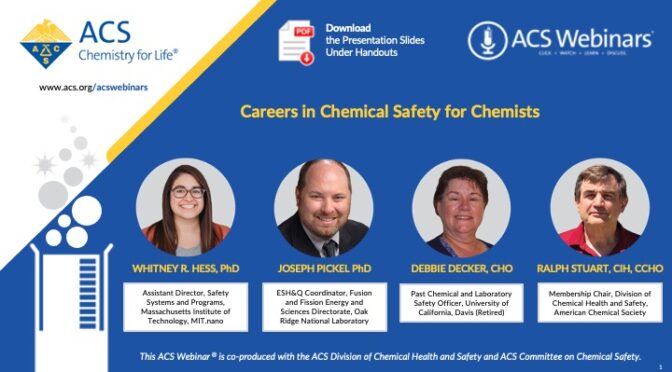
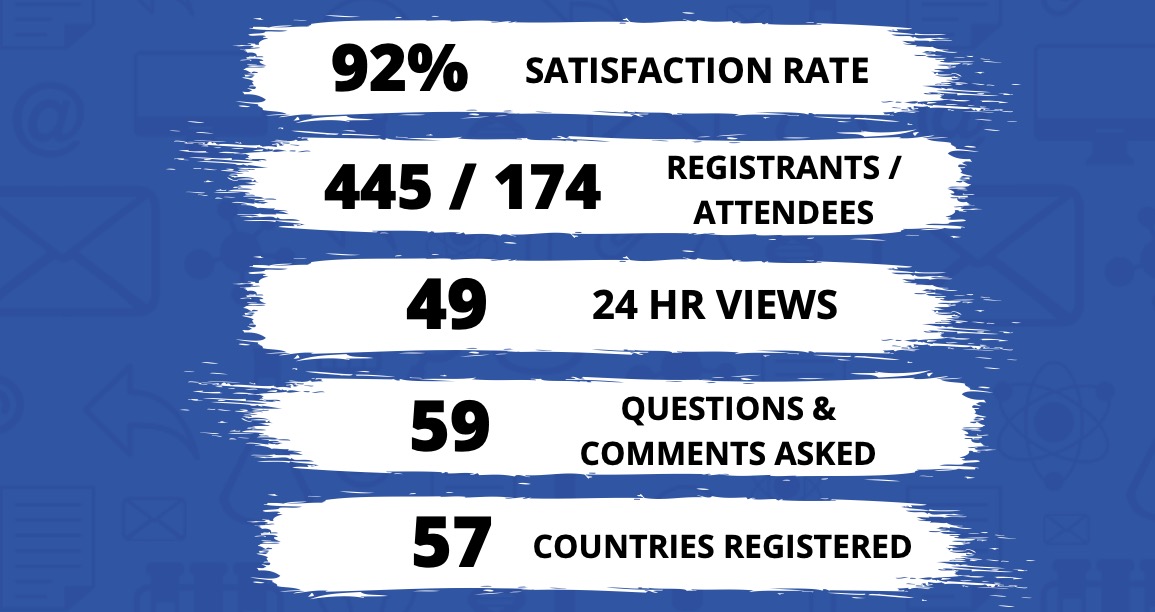
On May 12, 2022, three chemists who have found careers in environmental health and safety work discussed how they found their way into this field, the opportunities and challenges they have found in making the transition from the laboratory to the safety profession, and provided advice for other chemists considering this career transition.
The presentation file they shared is available below and the recording of the webinar is available at the ACS Webinars web site. The webinar included active audience participation, with several members of the audience sharing their own interests and experiences in the field.
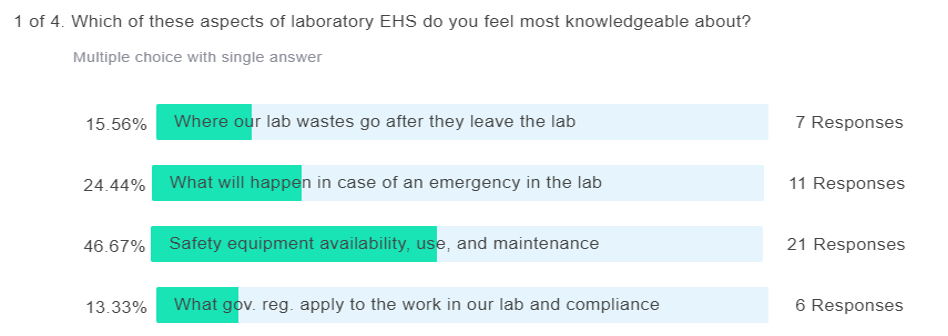
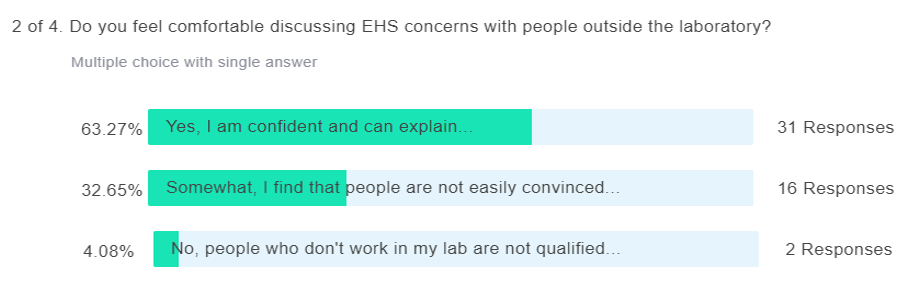
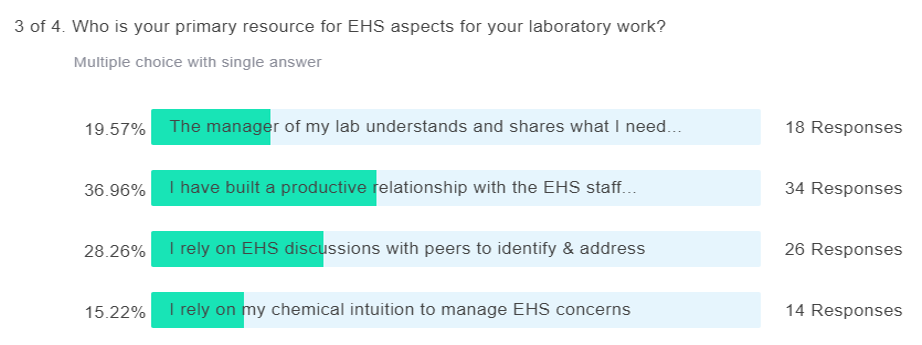
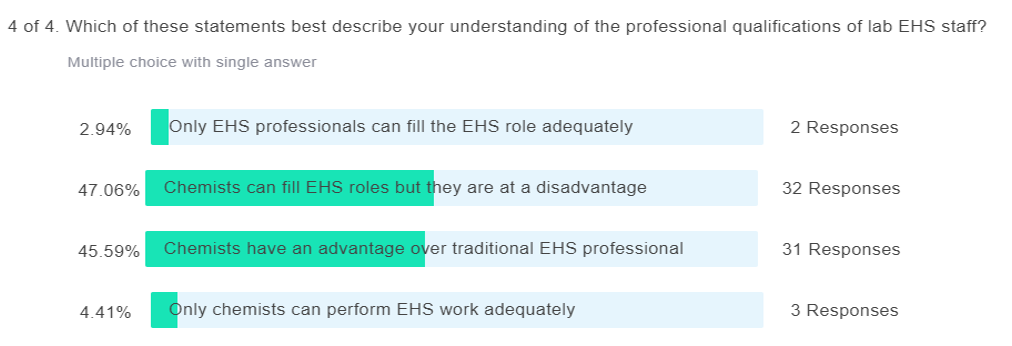
In addition to questions and answers from the audience, the webinar included 4 poll questions about their experience working with EHS professionals in their lab. Their responses are outlined in the figures below.
I work as a lab manager at a university that has an EHS department. I earned CHO certification purely for educational purposes. What type of position would I look for to actually use this certification and grow into a safety professional?
I worked in chemistry scale up for 20 years before moving into Safety –
Great to see the early career/late career questions being asked here – I think the presenters are saying this is an any time opportunity when it is right for you.
If your employer doesn’t have an EHS department – do you see this as an opportunity or a problem?
The engineering bias is there when things are written down in my experience too – I don’t think that is a blocker in practice.
Is there an on line space where people looking to connect through the comments can do that?
I would love to learn more about how to address a career in chem safety after being a CHO for my school and district and find a new position after retirement from teaching Chemistry for 30 years.
In past I have taken quite a few courses offered by Ken Roy ( NSTA consultant in Safety) while a teacher in CT and have helped to write my chemical Hygiene plan for our school and district and to introduce a Chemical Hygiene officer position. I believe our school and district has become safer as a result of the work.
I need to know how to gain certifications that can now support my skills and bring credibility to applying to positions in academic and or industry.
Need to know what certifications and courses to take? How to rewrite the resume to best apply for positions? Maybe someone might be willing here to share and to give me some help as a mentor to transition?
What kinds of opportunities exist for people freshly done with their undergraduate degree in the area ESH&Q opportunities, or is a Master’s/PhD required for these positions?
I work at a small, private liberal arts school that doesn’t have a EHS department. :/
I have 20 years industry experience as a formulator. I’m inspired that it’s not to late to switch to a safety career but concerned that my resume will be overlooked as either over or under qualified in that field, or both. What training might be available for such a transition without getting in over my head?
When I look at EHS positions, there appear to be far more looking for an engineering background than a chemistry background. Any tips for how to frame transferable skills for people who are in an engineering mindset?
What was that free course mentioned?
Perhaps someone can address an “encore” career transition after retiring from a technical career.
As a chemistry professor at a community college who also does not have an EHS department, I’ve found myself in the roll of needing to educate myself on the EHS concerns. What additional resources would be useful for those of us that need to help build institutional EHS departments?
At what point should an R&D organization have a dedicated “full-time” Chemical Hygiene Officer? Our site’s current CHO performs their EH&S duties in addition to their full-time R&D position.
Is there any great way of avoiding a near miss as far as Lab safety is concerned
And is a lab safety exam necessarily needed in academic Institutions for students doing a major that involves a wet lab environment
I have a bachelor’s in Chemistry and an MBA with a concentration in project management. I used to work in the raw-material lab for AkzoNobel in Brazil. I was responsible to generate security codes for handling raw materials in the manufacturing . Once I moved to the US, I had to change careers, but I am interested to go back into the scientific world and perhaps safety.
How can we start a joint training joint program funded by ACS with the academia in Egypt and Middle East?
Hi, Colin, safety professional in Pharma based in UK – great webinar so far – brilliant presentation from Whitney.
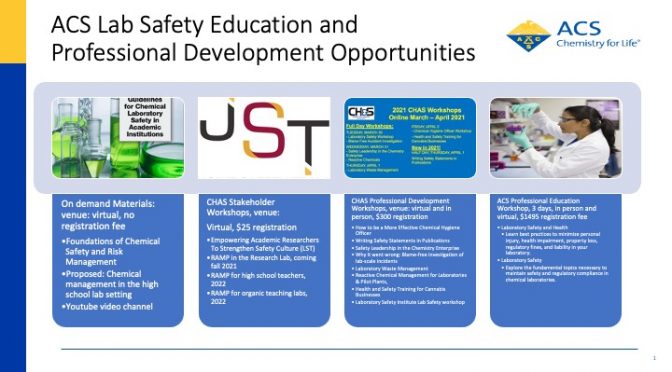
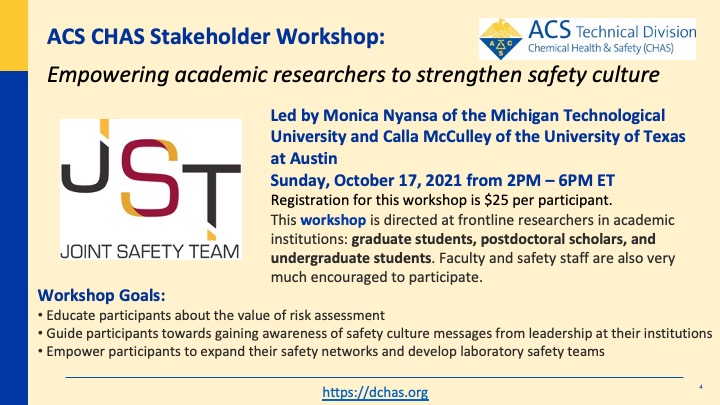
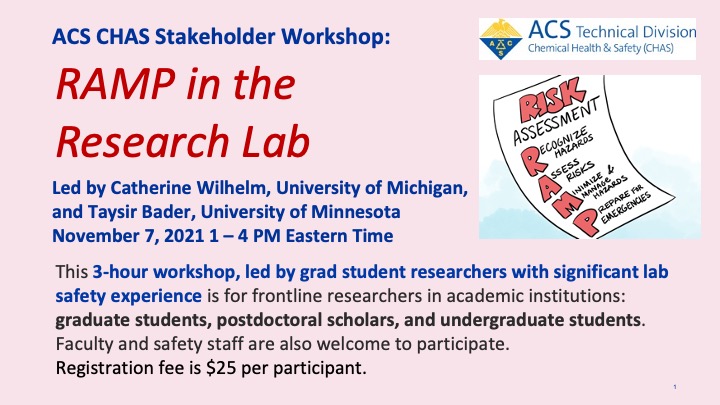
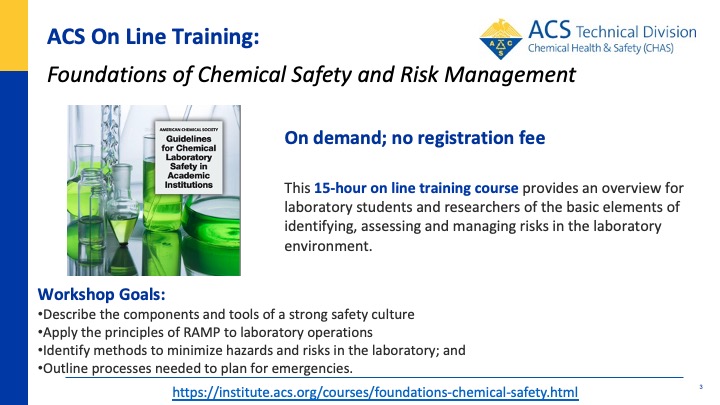
The Division of Chemical Safety presents several workshops as part of the American Chemical Society’s continuing education program around chemical safety issues. CHAS has two workshop tracks, aimed at either specific stakeholders or chemistry professionals who need specific chemical safety education to complete their expertise, either in the lab or in business settings. The stakeholder workshops are taught by people from that group with safety experience (e.g. grad students teaching grad students), whereas the professional development workshops are taught by full time Environmental Health and Safety professionals.
To register for any of these workshops, click on the the workshop description for that workshop.
We can also help arrange presentations of these workshops in other venues. If you are interested in arranging any of these trainings for your company or local section meetings, contact us at membership@dchas.org
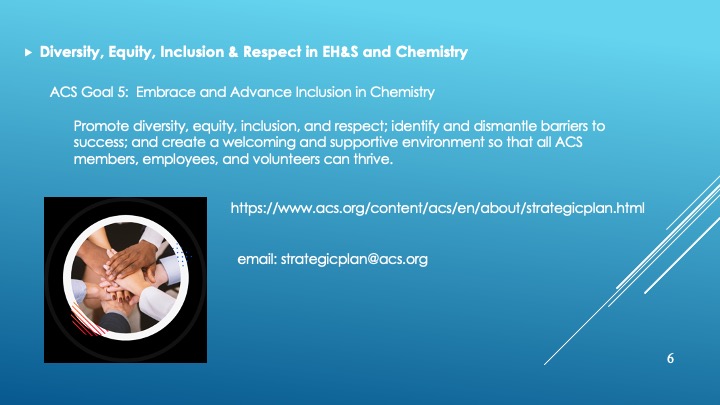
Diversity and inclusion in the workforce brings significant value to the employer[1]. Diversity in society broadens perspective, improves person to person socializing and creates a culture of openness and growth[2]. ACS has pledged to advance and embrace inclusion in chemistry, which includes promoting our core value of DEIR, identifying and dismantling barriers to success, and creating a welcoming environment so that all ACS members, employees, and volunteers can thrive.
Session leaders
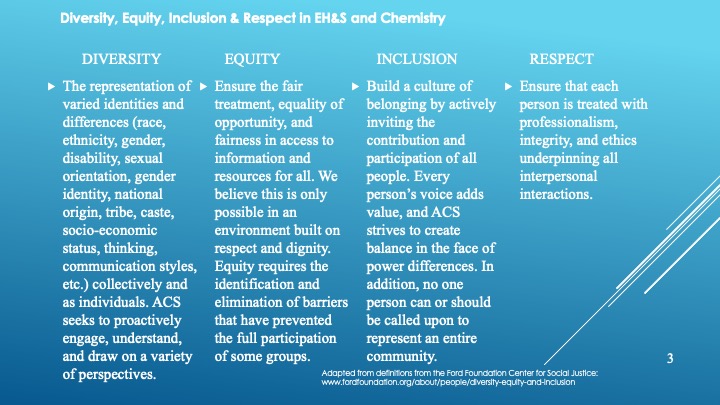
Some definitions
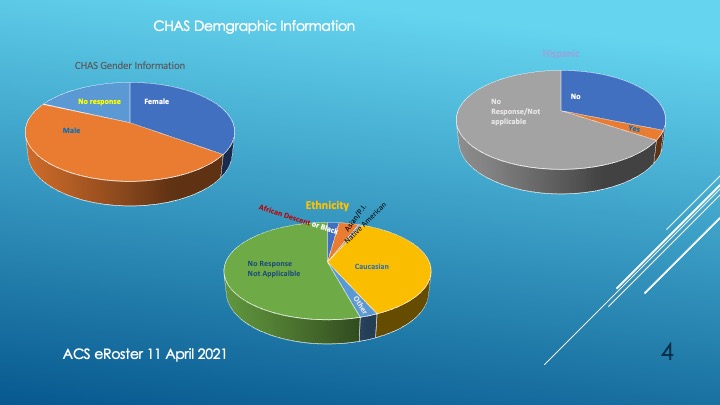
Current CHAS demographics
The Discussion
Inclusion in Chemistry and EHS
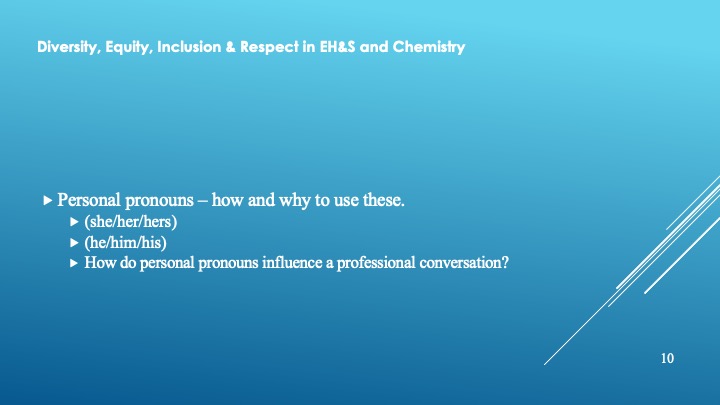
Using Pronouns
Recognizing the Challenge
Reaching Out
The Way Forward
Next Steps
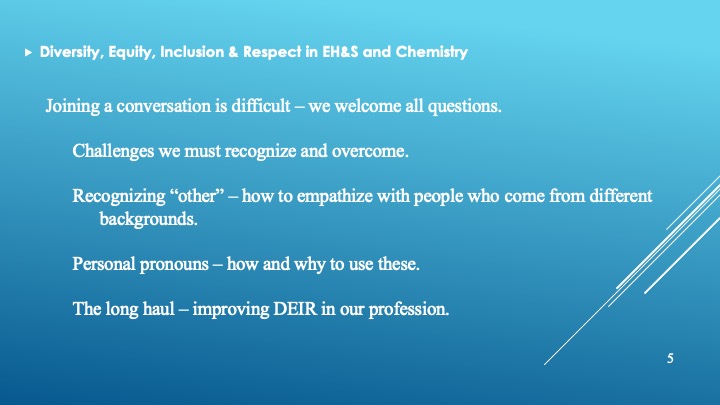
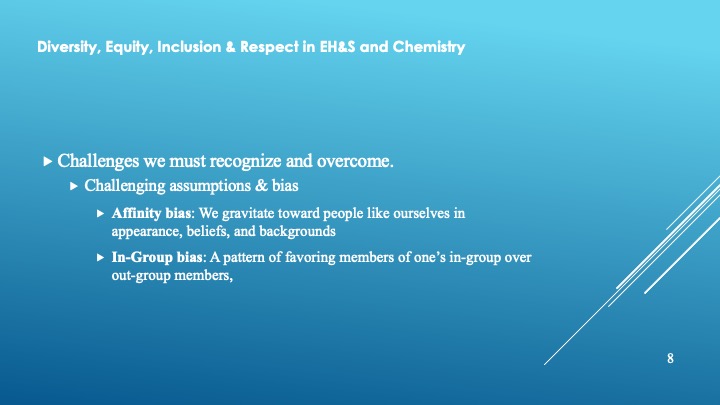
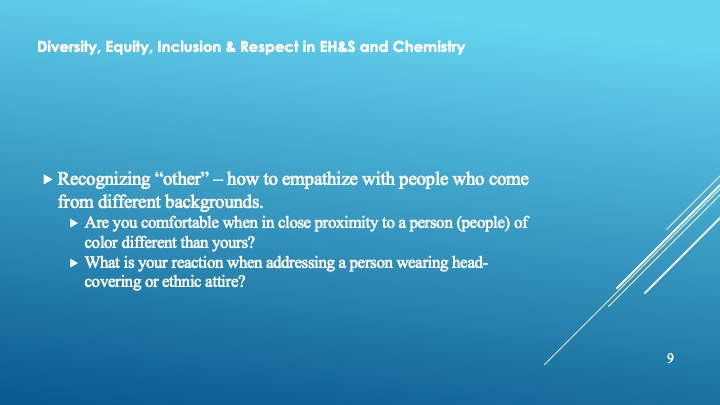
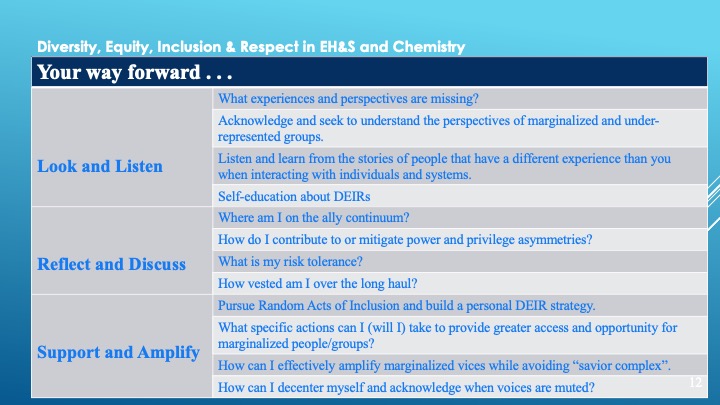
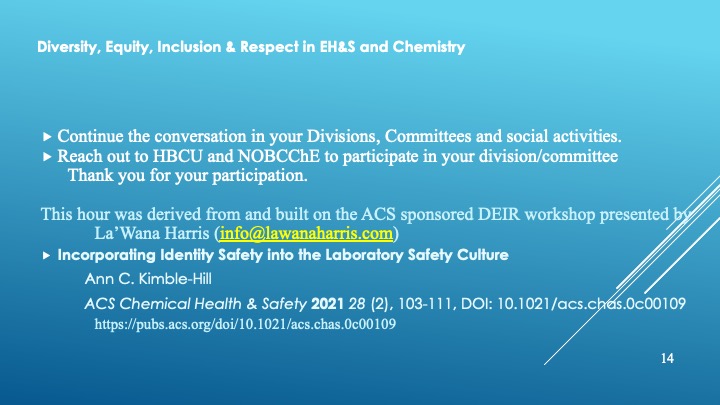
A group met to discuss the DEIR challenges in Chemistry and Environmental Health and Safety in April, 2021. The slides used to lead the discussion are shown here.
The event was co-hosted by:
Division of Chemical Health and Safety (CHAS)
Division of Business Development and Management (BMGT)
To register, scroll to the form at the bottom of this page
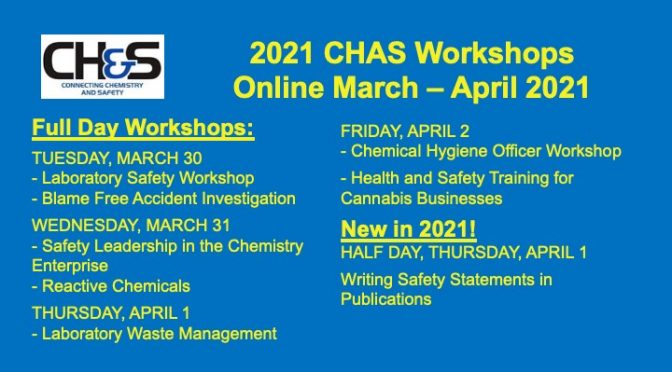
NEW for 2021: Half-day workshop on Writing Safety Statements in Publications
Thursday, April 1, 1 PM Eastern Daylight Time, $150
The ACS now requires that authors include a statement of safety concerns in manuscripts submitted to ACS journals. The 2020 edition of the ACS Guide to Scholarly Communication, section 1.3 (Communicating Safety Information) provides guidelines to developing appropriate information for scholarly communication, but there are no complete examples provided, only excerpts. Furthermore, the chapter provides only information—it cannot impart the knowledge and skills necessary to carry out the instructions in the section. The purpose of this workshop is to put into practice the guidelines for writing effective safety statements based on the science and the intended audience using risk assessment.
Presented by: Sammye Sigmann, Leah McEwen, Daniel Kuespert
Laboratory Waste Management 2021, $300
Thursday, April 1, 11 AM Eastern Daylight Time
CHAS offers the Laboratory Waste Management workshop to assist participants with the various regulatory requirements that apply to laboratories which generate hazardous waste, as well as to provide insight into the options for on-site management and off-site disposal. Includes details on the Hazardous Waste Improvement Rule and how it impacts laboratories. Focus will include discussion on recycling/ reclamation techniques, economical handling of wastes and liability issues. There is extensive opportunity for questions both during the workshop with follow-up by phone and email.
How to be a more effective Chemical Hygiene Officer, $300
Friday, April 2, 11 AM Eastern Daylight Time
CHAS offers the How to be a more effective Chemical Hygiene Officer workshop to provide participants with a detailed analysis of the CHO position and to prepare for the NRCC Chemical Hygiene Officer Board Certification exam. Participants receive a clear perspective on safety issues in the laboratory, focusing on what the CHO does and how to do it better. OSHA, EPA & DOT regulations that impact laboratory operations are included in the discussion.
The workshop covers the content areas of the NRCC certification exam, including a sample test in the same format as the real one. Whether you are a new Chemical Hygiene Officer or an “old” one, you will find something to put to real use in this fast-paced presentation. There is extensive opportunity for questions during the workshop and with follow-up by phone and email.
taught by Russ Phifer, Jim Kaufman (Note that the Chemical Hygiene Officer certification exams are offered online. These exams are managed by the National Registry of Certified Chemists. Visit their web site at http://www.nrcc6.org for further information.)
Registration Notes:
One person may register for multiple workshops on a single Registration form. If you have more than one person to register using the same credit card or billing method or if you need help with the registration process, please contact Russ Phifer at 610-322-0657 or rphifer@wcenvironmental.com
You will receive a confirmation that your registration has been submitted immediately upon registering. You will be sent a confirmation of registration email as soon as your registration is reviewed. Please contact 610-322-0657 if you do not receive the confirmation within four working days.
[sform]10[/sform]
Note: Conditions and Cancellation/Refund Policy
Upon verified registration, information will be sent to each participant containing specific location information of the workshop. Companies may substitute registrants without prior notice or penalty.
Full refund available for cancellations up to three (3) weeks prior to workshop date. 50% refund up to one (1) week prior to workshop. Cancellations made less than seven (7) days prior to workshop start date will be charged, but an 80% credit may be applied toward a future program. No-shows receive no credit and will be billed.
In the event that the Division of Chemical Health and Safety is forced to cancel a workshop due to lack of registration or other causes, CHAS will notify participants at least ten (10) days in advance by email. We will notify you by email as soon as we know that the workshops will be held, i.e. we have sufficient registrants to present the workshop.
The annual open membership meeting of the Division of Chemical Health and Safety will be held virtually this year. Traditionally this is held at one of the 2 ACS national meetings, but because it is not clear if there will be any in person ACS meetings this year, the CHAS Executive Committee has decided to hold it on April 15, from noon – 2 PM, Eastern time. The meeting will be held on Zoom at https://princeton.zoom.us/j/92215412283
If you are curious about how the Division works, want to get caught up on the latest news (traditionally spring meeting includes the announcement of the CHAS award winners for the year!) or would like to get involved helping the Division do its work, please join us!
The 2020 CHAS elections will take place in May this year. The slate of candidates for this year’s election is provided below.
Candidate for Chair Elect
Chris Incarvito
Candidate for Secretary
Monique Wilhelm
Candidates for Councilor (highest number of votes)
Alternate Councilor (second highest number of votes)
Brandon Chance
Frankie Wood-Black
Joe Pickel
Candidates for Member at Large
Kendra Denlinger
Joseph Crockett
Candidate for Chair Elect
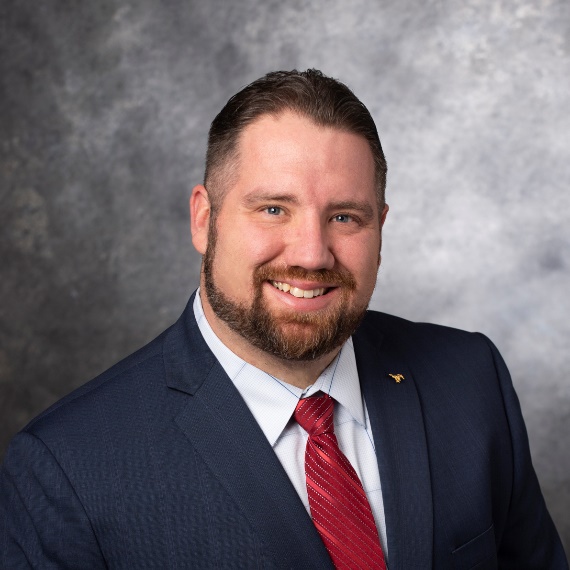
Christopher Incarvito, PhD, Associate Provost for Science Initiatives Yale University
Dr. Incarvito joined Yale University in 2002 and currently serves as the Associate Provost for Science Initiatives. In this role he has broad responsibility for strategic planning and programmatic development in support of Yale’s Science Strategy – an ambitious prioritization of interdisciplinary and integrative initiatives that will catalyze new research programming and supplement existing research excellence.
He serves on a multitude of university committees including the EHS Laboratory Safety Committee and has worked collaboratively with Yale EHS on projects ranging from campus-wide chemical inventory systems, new safety policy development, and safety-driven laboratory renovations and retrofits.
The balance of his portfolio is in overseeing research operations and strategic scientific development of Yale West Campus, where he is responsible for the quality and creation of new research programming and facilities through collaborative work with faculty, directors, deans, department chairs, and other university leadership. He also spearheads an ambitious program of laboratory modernization across West Campus, delivering a significant expansion of Yale’s science and engineering capacity, and manages strategic capital investments, deployment of high-value shared research instrumentation laboratories, and collaborations with global scientific research organizations.
Dr. Incarvito has been a member of D-CHAS for eight years and has served as the division’s Development Chair for the last two. He was also named a CHAS Fellow in 2018.
He earned a PhD in inorganic chemistry from the University of Delaware in 2002 and his continued research interests include the application of orthogonal analytical instrumentation to complex chemical and biological problems. His current professional interests are in modern laboratory design, specifically in the creation of spaces that support interdisciplinary research efforts, shared resources, and safety-driven design.
Secretary
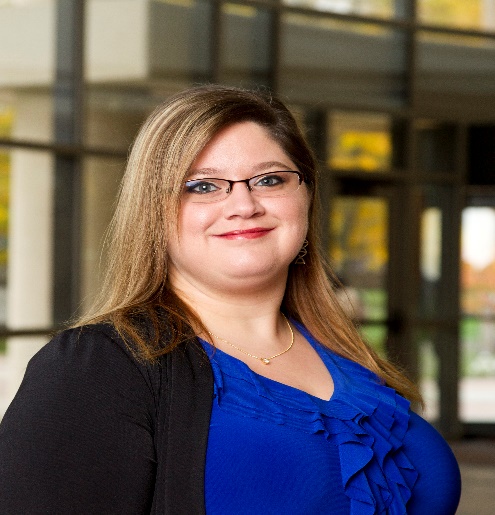
Monique Wilhelm, M.S., NRCC Certified CHO Laboratory Manager, Adjunct Lecturer, Chemistry Club Advisor Department of Chemistry & Biochemistry|University of Michigan-Flint
ACS CHAS Secretary|2017 CERM E. Ann Nalley Award Recipient
Monique Wilhelm is the Laboratory Manager in the Department of Chemistry & Biochemistry at the University of Michigan-Flint. Her work involves all business and operations within the chemistry labs including maintenance of instrumentation and all functions related to laboratory safety. She has an M.S. in Chemistry, HAZWOPER Specialist certification, and is an NRCC Certified Chemical Hygiene Officer. She was the 2018-2020 secretary for the executive board of the American Chemical Society (ACS) Division of Chemical Health and Safety, is a member of the Safety Committee within the ACS Division of Chemical Education, and is an advocate for science literacy and the improvement of the popular view of chemistry.
Councilor (highest number of votes)
Alternate Councilor (second highest number of votes)
Brandon S. Chance, MS, CCHO Director of Environmental Health and Safety Southern Methodist University
Brandon holds bachelor’s and master’s degrees in chemistry with an emphasis on polymer and organic chemistry from Texas Lutheran University and Texas A&M University and has been an ACS member for 13 years. After serving as a bench chemist and researcher in academia and industry for four years, Brandon transitioned a role in environmental health and safety in 2008.
Over the last decade he has held various positions at Texas A&M University at Qatar, Princeton University, and most recently at Southern Methodist University, where he is currently the Director of Environmental Health and Safety. Brandon routinely gives talks at both Campus Safety Health and Environmental Management Association (CSHEMA) and American Chemical Society (ACS) national meetings.
He currently sits on the Executive Committee of the ACS Division of Chemical Health and Safety (DCHAS) as an Alternate Councilor and Liaison to the Division of International Activities and is also on the conference education committee for CSHEMA and is a co-organizer for the 2020 CSHEMA Safety Symposium on Safety Culture. Brandon is an ACS-DCHAS Fellow and an ACS ChemLuminary Award recipient for Global Engagement. In addition to national talks, Brandon has also served as an invited speaker and panelist at various ACS International events including events in Malaysia and Qatar that focus on laboratory safety and security in conflict regions and international settings.
Frankie Wood-Black, Ph.D., REM, MBA Principal – Sophic Pursuits
Dr. Frankie Wood-Black has been a member of the Division since the early 1990’s. She has been active in Divisional Activities throughout this time and has held a number of roles in the Division including the Chair and Counselor. While representing the Division, she has been a member of a number of ACS committees and has participated in many governance activities, and currently is a member of the Nominations and Elections Committee for the ACS. In addition, to her ACS activities, Dr. Wood-Black was an industrial scientist working in the areas of environmental compliance, sustainability, and chemical management. In 2014, she left industry to return to academia and is currently the Division Chair for the Engineering, Physical Science, and Process Technology at Northern Oklahoma College, in Tonkawa, OK.
Joseph (Joe) M. Pickel, Ph.D., CCHO
Joe received his B.S. in Chemistry from Villanova University in 1998 and his Ph. D. in Polymer Chemistry from the University of Akron in 2003. After graduate school, he began working as a postdoctoral researcher at Oak Ridge National Laboratory (ORNL) in Tennessee and soon after became a Research and Operations Staff member at the Center for Nanophase Materials Sciences serving as chemical inventory manager, environmental protection officer, and work control coordinator for this division. In 2012 he became the Research Support Group Leader for the Chemical Sciences Division, responsible for coordinating all aspects of ESH, quality and operational activities within the division. He is also responsible for the Work Planning and Control process for all R&D at ORNL.
He joined ACS in 1996 and has been a member of CHAS since 2007. Joe has also been a member of the Division of Polymer Chemistry and the Division of Chemical Information. As a member of CHAS, Joe has organized numerous symposia including several Presidential symposia and given presentations in the area safety of nanomaterials, chemical management, research facility design, and other topics. He has been an active volunteer in CHAS serving as Chair (2018) Membership Chair, Alternate Councilor and co-chair of the Programming Committee. He has been a Certified Chemical Hygiene Officer with the National Registry of Certified Chemists since 2007 and serves on its Board of Directors.
Member at Large
Kendra Leahy Denlinger, Ph.D. Teaching Professor of Chemistry Xavier University, Cincinnati, OH
I am a Teaching Professor of Chemistry at Xavier University in Cincinnati, OH, where I started working in the fall of 2017 after earning my Ph.D. in chemistry from the University of Cincinnati. During my last year of graduate school, I participated in a 6-week internship with ACS in Washington, D.C., and I have been involved with the chemical safety community ever since. During this internship, I developed a presentation about the ACS website Hazard Assessment in Research Laboratories, which I presented at my graduate institution as well as at Keene State College, Harvard University, and MIT.
My graduate research background is in green chemistry, which is why I was drawn to the area of chemical safety. Chemical safety and green chemistry complement each other, and I believe there are many benefits to closer collaboration between the two. I have been involved with the ACS Committee on Chemical Safety since fall of 2018 and am currently serving as an associate member. I am a member of the Division of Chemical Health and Safety, and am currently working on a project with the division funded by an ACS Innovative Project Grant. We are designing an electronic tool to help guide undergraduate chemistry laboratory students through the RAMP process.
I have enjoyed working with the chemical safety community and learning from them, so I am excited to get more involved with the division in serving as a Member-at-Large!
Joseph M Crockett A LeRoy and Wanda H Baker Chair of Science Professor of Chemistry Department of Chemistry Bridgewater College
I am the A Leroy and Wanda H Baker Professor of Science and Professor of Chemistry at Bridgewater College (retiring this year after 43 years teaching). I have been involved with lab safety in different aspects for my entire career. I instituted the lab safety program at Bridgewater, one level for freshmen and sophomores and an upper level for Chemistry majors. I have chaired the safety committee for the Virginia Section ACS, I have been a member of CHAS for 27+ years, I am a member of the Committee on Chemical Safety ACS, and I have worked on several project including the writing of the new ACS test on Chemical Health and Safety.